



The endocannabinoid system (ECS) is a complex cell-signalling network that regulates essential functions – including mood, sleep, appetite, immune response and metabolism – to maintain internal balance (homeostasis).1-3
Most of us know about our nervous or digestive systems, but did you know you also have an endocannabinoid system? This lesser-known system plays an important role in balancing key bodily functions.
This article explores how the ECS works, the role of endocannabinoids, and practical diet and lifestyle strategies to help support ECS function and your health.
What is the endocannabinoid system?
The endocannabinoid system (ECS) is like a vast communication network that interacts with multiple body systems to help maintain homeostasis (balance).1-3
The ECS is made up of 3 main components:
- Endogenous cannabinoids (endocannabinoids)
- Cannabinoid receptors
- Enzymes1-3
What are endocannabinoids? (the signals)
Endocannabinoids are essentially molecules that communicate a certain message to the body to initiate a response. They are naturally occurring signalling molecules that activate cannabinoid receptors. Two of the most researched endocannabinoids include:
- Anandamide (AEA) (ananda is the Sanskrit word for ‘bliss’)
- 2-arachidonoyl glycerol (2-AG)3
A healthy human body can produce them on demand as the body needs them.4 It has been proposed that imbalances within the ECS, such as excess or deficient endocannabinoids, may be linked to certain conditions and symptoms.5
Cannabinoid receptors – the receivers
Cannabinoid receptors receive messages from the endocannabinoids. They are located on the surface of many different cell types throughout the body.6 When endocannabinoids bind to these receptors, this signals to the ECS to trigger a response. Researchers have identified two primary cannabinoid receptors within the body:
- CB1 receptor (cannabinoid receptor type 1) – predominantly found in the brain and nervous system
- CB2 receptor (cannabinoid receptor type 2) – predominantly found in the immune system3,6
Cannabinoid receptors are predominantly found in the central nervous system, but are also located in diverse organs and systems, including immune, liver, reproductive, gastrointestinal, cardiovascular, skin and more.3,6
Enzymes – the control switch
Enzymes in the ECS are responsible for the synthesis and breakdown of endocannabinoids.2 This means that certain enzymes will help produce endocannabinoids on demand, and other enzymes can then break endocannabinoids down again, essentially acting as an on/off switch.
There are two main enzymes responsible for this:
- Fatty acid amide hydrolase (FAAH) – which breaks down anandamide (AEA)
- Monoacylglycerol lipase (MAGL) – which typically breaks down 2-arachidonoyl glycerol (2-AG)2
These two enzymes can up-regulate or down-regulate the endocannabinoid system by increasing or decreasing endocannabinoid levels within the body.
What does the endocannabinoid system do?
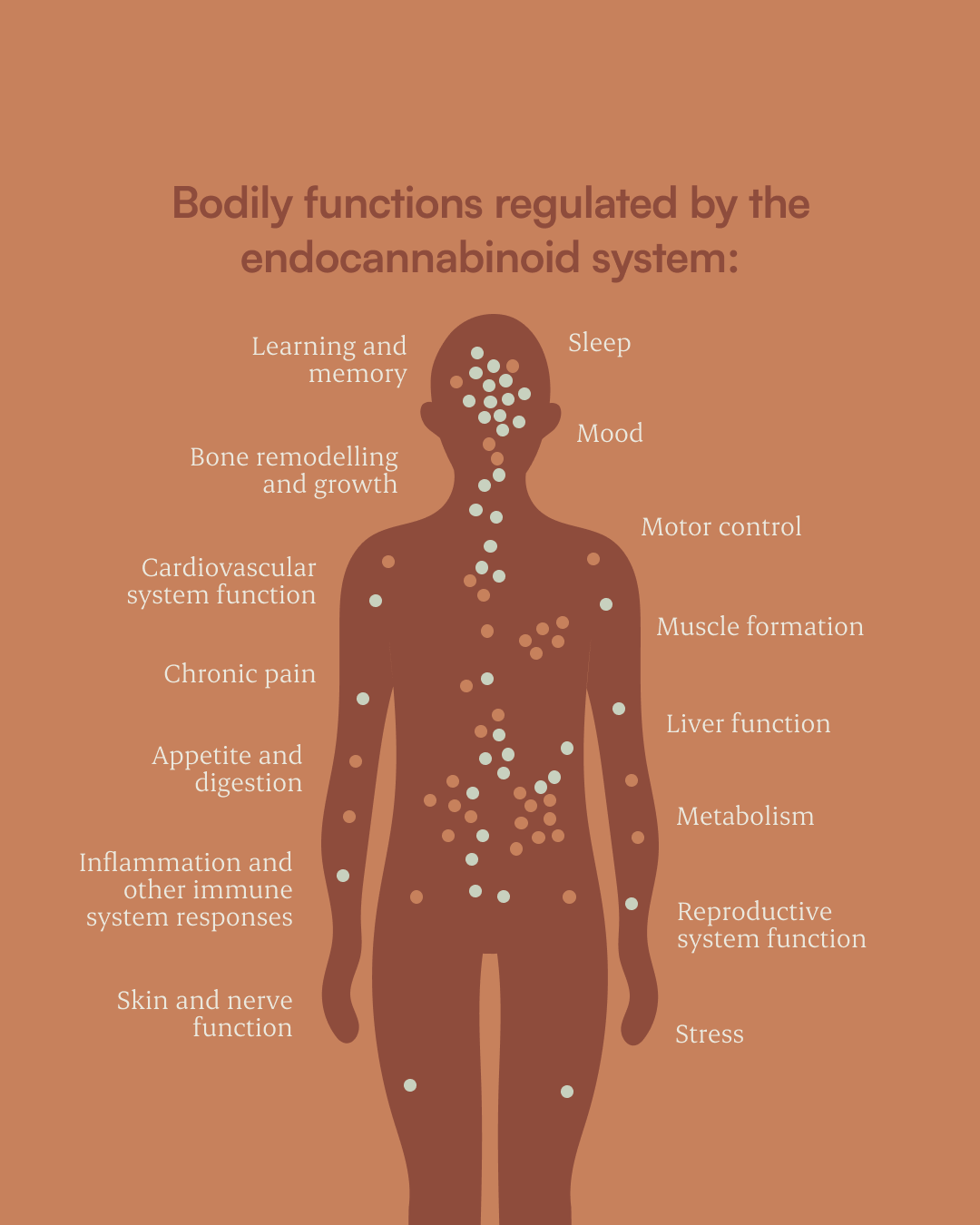
The ECS acts as a regulator that fine-tunes the body’s responses to internal and external stimuli, supporting adaptive responses. It helps regulate internal environments through modulating different body systems, including:2
- Gastrointestinal function
- Temperature regulation
- Heart function
- Pain response
- Immune modulation
- Learning, memory and cognition
- Liver function
- Emotional behaviour
- Sleep
- Reproductive function and more2,7
All of these functions contribute to the stability and balance of your body.
How does the endocannabinoid system work?
Each component of the ECS – endocannabinoids, cannabinoid receptors and enzymes – works together to support balance within the body, following a cycle of synthesis, release, uptake and degradation.4
While research into the mechanisms behind ECS responses continues, it is proposed that when a system or function in the body is out of balance, endocannabinoids bind to cannabinoid receptors to help restore balance.1-3 Once the endocannabinoid system brings the body back into balance, enzymes will break down the cannabinoids to prevent overcorrecting the problem.8
Imbalances with any of the ECS components, including receptors, enzymes or endocannabinoids, are increasingly being linked to symptoms, such as dysregulated stress responses and altered appetite. This has led to growing interest in therapeutic applications that support ECS function, either through diet, lifestyle or medications.5,6,8-11 Due to the complexity of the ECS, there is still much to be learned and understood.
How can you support your endocannabinoid system naturally?
New research has expanded the ECS into a broader system known as the endocannabinoidome (eCBome) – that includes additional signal molecules and receptors that share similar pathways to endocannabinoids, supporting their actions.11 Several simple diet and lifestyle changes can help support and regulate your ECS. Some of these include:
- Fuel up with omega-3s: Consuming adequate omega-3 fatty acids in your diet – such as those found in fish – can help support endocannabinoid signalling and appear to have a modulating effect, with the ability to support upregulation and downregulation of ECS components.5
- Nurture your gut: The gut microbiome and eCBome are closely linked via a two-way communication pathway, referred to as the eCBome-gut microbiome axis.12 Imbalances in the gut microbiome can affect the eCBome and vice versa.12 Supporting your microbiome with a healthy, Mediterranean-style diet and exercise has shown in research to have beneficial effects on the eCBome-gut microbiome axis.11
- Spice up your life with terpenes: Many herbs and spices – such as oregano, cinnamon and rosemary – are rich in substances known as terpenes, which are natural compounds that give herbs and spices their aroma and flavour.13 Terpenes have shown to have a positive effect on the endocannabinoid system and may help to regulate inflammation, mood and metabolic function.13
- Power up with active movement: Certain types of exercise can help upregulate endocannabinoids. Studies have shown that moderate to high intensity aerobic activity, such as running and cycling, is linked to increased production of endocannabinoids when compared to lower intensity exercise, such as walking.5
- Master your stress: Prolonged periods of stress can dysregulate the endocannabinoid system, with some research showing increased amounts of the stress hormone cortisol can interfere with the function of CB1 receptors.5 Finding ways to manage stress, such as yoga, meditation and deep breathing, may help regulate the ECS.5
The bottom line
Although there is still much research to be done, studies to date suggest that the endocannabinoid system plays an important role in regulating our internal bodily systems and functions, and therefore, our health and wellbeing. Diet and lifestyle changes can be a useful way to help modulate the endocannabinoid system and support balance.5 For more on bringing different approaches together, see our guide to whole-person care.
Want to talk to a doctor experienced in the endocannabinoid system? Speak to one of our Polln doctors today.
- Sallaberry C, Astern L. The endocannabinoid system, our universal regulator. Journal of Young Investigators. 2018 Jun;34(6):48-55. Available from: https://www.jyi.org/2018-june/2018/6/1/the-endocannabinoid-system-our-universal-regulator
- Lowe H, Toyang N, Steele B, Bryant J, Ngwa W. The endocannabinoid system: a potential target for the treatment of various diseases. International Journal of Molecular Sciences. 2021 Aug 31;22(17):9472. Available from: https://www.mdpi.com/1422-0067/22/17/9472
- Rezende B, Alencar AK, de Bem GF, Fontes-Dantas FL, Montes GC. Endocannabinoid system: chemical characteristics and biological activity. Pharmaceuticals. 2023 Jan 19;16(2):148. Available from: https://www.mdpi.com/1424-8247/16/2/148
- Lu HC, Mackie K. Review of the endocannabinoid system. Biological Psychiatry: Cognitive Neuroscience and Neuroimaging. 2021 Jun 1;6(6):607-15. Available from: https://pmc.ncbi.nlm.nih.gov/articles/PMC7855189/
- McPartland JM, Guy GW, Di Marzo V. Care and feeding of the endocannabinoid system: a systematic review of potential clinical interventions that upregulate the endocannabinoid system. PLoS One. 2014 Mar 12;9(3):e89566. Available from: https://pmc.ncbi.nlm.nih.gov/articles/PMC3951193/
- Guindon J, Hohmann AG. The endocannabinoid system and pain. CNS & Neurological Disorders – Drug Targets. 2009 Dec 1;8(6):403-21. Available from: https://pmc.ncbi.nlm.nih.gov/articles/PMC2834283/pdf/nihms165245.pdf
- Zou S, Kumar U. Cannabinoid receptors and the endocannabinoid system: signaling and function in the central nervous system. International Journal of Molecular Sciences. 2018 Mar 13;19(3):833. Available from: https://www.mdpi.com/1422-0067/19/3/833
- Șerban M, Toader C, Covache-Busuioc RA. The endocannabinoid system in human disease: molecular signaling, receptor pharmacology, and therapeutic innovation. International Journal of Molecular Sciences. 2025 Nov 18;26(22):11132. Available from: https://pmc.ncbi.nlm.nih.gov/articles/PMC12653933/
- Mušić T, Turnšek TL. The endocannabinoid system in neuropsychiatric disorders: mechanisms, dysregulation and therapeutic potential. Biomedicines. 2026 Apr 23;14(5):968. Available from: https://www.mdpi.com/2227-9059/14/5/968
- Blebea NM, Pricopie AI, Vlad RA, Hancu G. Phytocannabinoids: exploring pharmacological profiles and their impact on therapeutical use. International Journal of Molecular Sciences. 2024 Apr 10;25(8):4204. Available from: https://www.mdpi.com/1422-0067/25/8/4204
- Wang Y, Guo J, Mao Z, Chen Y. Symphony of the gut microbiota and endocannabinoidome: a molecular and functional perspective. Frontiers in Cellular and Infection Microbiology. 2025 Mar 26;15:1566290. Available from: https://www.frontiersin.org/journals/cellular-and-infection-microbiology/articles/10.3389/fcimb.2025.1566290/full
- Silvestri C, Di Marzo V. The gut microbiome–endocannabinoidome axis: a new way of controlling metabolism, inflammation, and behavior. Function. 2023;4(2):zqad003. Available from: https://journals.physiology.org/doi/full/10.1093/function/zqad003
- Vago R, Fiorio F, Trevisani F, Salonia A, Montorsi F, Bettiga A. The Mediterranean diet as a source of bioactive molecules with cannabinomimetic activity in prevention and therapy strategy. Nutrients. 2022 Jan 21;14(3):468. Available from: https://www.mdpi.com/2072-6643/14/3/468
The information on this website is provided for educational and informational purposes only and is not intended as medical advice. Prescription medicines in Australia are regulated by the Therapeutic Goods Administration (TGA). If you have questions about your health or treatment options, please speak to your registered medical practitioner.
Our caring doctors are here to help every step of the way.
Appointments available same day, after hours and weekends.